
//
Operations
// Network &
Security Operations Center
for resilient 24/7 business continuity
ARMIS Network & Security Operations Center (NOC/SOC), powered by OZONO, helps organizations keep critical IT services available, secure, and under control after implementation. It combines 24/7 monitoring, 1st and 2nd line support, network and security operations, service-level tracking, and executive reporting so leaders can protect continuity, reduce operational exposure, and free internal teams to focus on transformation.
Powered by OZONO’s Operations Center to keep critical IT services available, secure, and under control.


//
THE CHALLENGE
Critical services cannot depend on reactive operations
Once critical IT services go live, leadership needs more than reactive support. They need continuity, service visibility, incident coordination, security awareness, and clear accountability across complex environments. Without a structured NOC/SOC model, operational pressure increases, escalation becomes harder to control, and business continuity depends too much on fragmented tools and manual follow-up.
Reactive support
Issues are addressed after impact, increasing pressure on internal teams.
Fragmented visibility
Monitoring is dispersed across tools, environments, and service owners.
Slow escalation
Incidents take longer to qualify, route, and resolve.
SLA pressure
Service levels become harder to prove without structured reporting.
Security exposure
Security events need continuous triage and operational response.
Limited continuity
Business resilience depends on predictable operations and clear accountability.
//
NOC/SOC OPERATING LAYER
One operating model for the services your business depends on
ARMIS NOC/SOC provides one accountable operating layer for the IT services your business depends on. Powered by OZONO’s Operations Center, it brings together network operations, security operations, service desk support, and escalation management within a single operational framework.
The model also integrates maintenance coordination, service-level tracking, reporting, and continuous operational governance, helping organizations maintain visibility, continuity, responsiveness, and control across critical business services.



// 1st Line Support
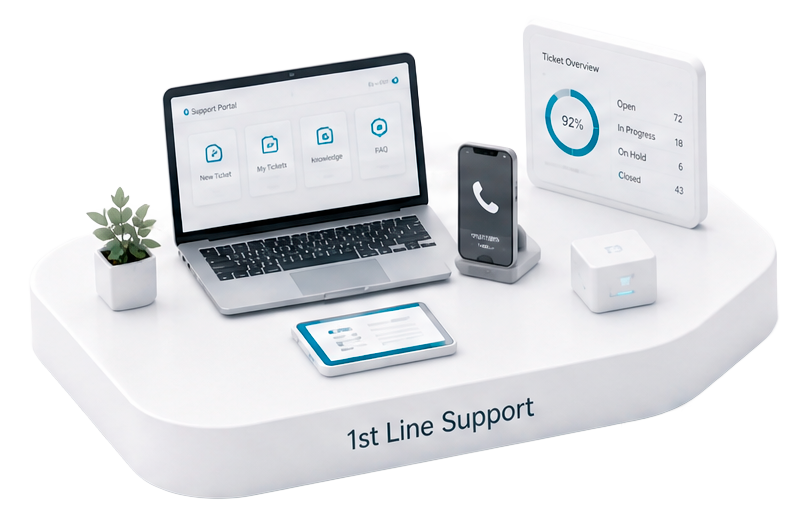
Customer-facing support through phone, web channels, ticket follow-up, status visibility, and coordination with 2nd line teams.
// 2nd Line Support
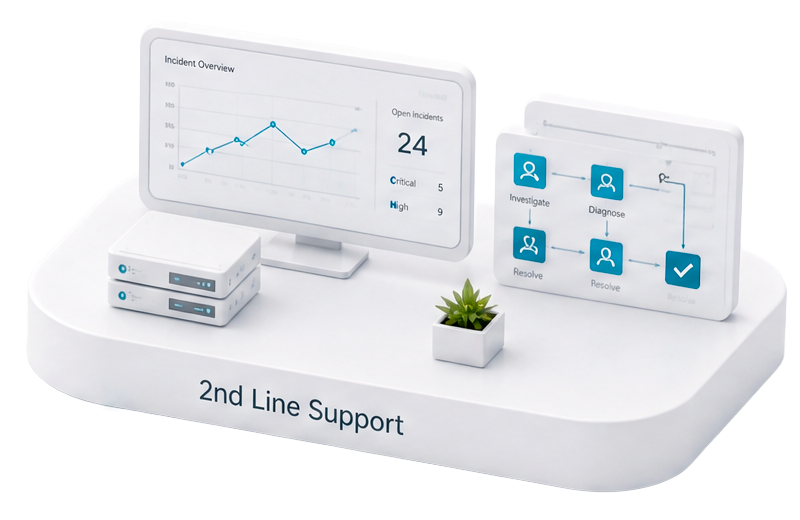
Technical assessment of incidents, corrective maintenance, escalation to specialized teams, and identification of evolutive maintenance needs.
// 24/7 Network Operations Center
Continuous monitoring and management of networks, servers, endpoints, cloud resources, and service availability.
// 24/7 Security Operations Center
Continuous security monitoring, alert triage, threat visibility, incident response coordination, and security-aware operational control.
// Contract Management
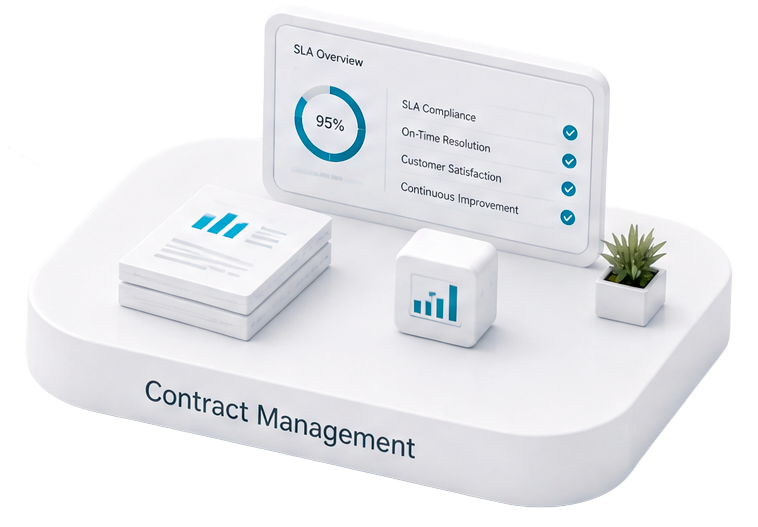
Tracking of service levels, response times, resolution metrics, reporting, contractual compliance, and continuous improvement.
//
How it works
From service handover to continuousNOC/SOC control
A governed operating model for visibility, continuity, accountability, and improvement.
Every service is integrated into ARMIS operations through a governed lifecycle: handover, monitoring definition, access assessment, operational setup, 24/7 monitoring, support workflows, reporting, SLA control, and continuous improvement. The NOC/SOC can operate remotely, onsite, or through a hybrid model depending on each client’s operational sensitivity, security requirements, and business priorities.
01
Prepare the handover
ARMIS maps the implemented service, dependencies, risks, escalation paths, service levels, and business-critical priorities.
02
Define monitoring and access
Monitoring rules, remote access, operational dashboards, reporting needs, support workflows, and ownership are configured before go-live.
03
Operate 24/7
OZONO’s Operations Center provides continuous visibility, ticket follow-up, alert triage, incident coordination, and operational control.
04
Escalate with accountability
1st and 2nd line support work in articulation with specialized teams to resolve corrective issues and identify evolutive needs.
05
Report and improve
Service levels, response times, resolution metrics, compliance evidence, and improvement opportunities are tracked continuously.
//
OPERATIONAL VISIBILITY
From fragmented alerts to accountable response
Turn operational signals into clear priorities, coordinated action, and measurable service control.
ARMIS NOC/SOC helps organizations turn dispersed operational signals into clear priorities and accountable response. Network, infrastructure, endpoint, cloud, and security signals are monitored and connected to support workflows, escalation paths, maintenance actions, and service-level reporting. When appropriate, assisted correlation and automation support faster triage, lower operational noise, and more consistent service control.

// Network visibility
Continuous monitoring helps identify availability, performance, and connectivity issues across critical services.

// Security monitoring
Threat signals, suspicious activity, and security events are triaged within an operational response model.

// Incident prioritization
Alerts and tickets are classified by urgency, business impact, service level, and escalation path.

// Maintenance coordination
Preventive, corrective, and evolutive maintenance are connected to the service lifecycle and client priorities.

// Operational reporting
Response times, resolution metrics, SLA compliance, and improvement opportunities are tracked and reported.
//
Who it is for
Built for organizations that cannot afford service disruption
Designed for enterprise environments where service continuity, governance, and operational confidence are critical.
ARMIS NOC/SOC is designed for organizations whose business depends on secure, continuous, and predictable technology operations. It is especially relevant for leaders managing complex networks, hybrid infrastructure, distributed endpoints, cloud resources, security-sensitive environments, business-critical applications, or service contracts where visibility, accountability, and consistent response are essential.
IT and operations leaders
Teams that need to improve service reliability, reduce operational noise, and keep complex environments under control.
Lean internal teams
Organizations that need 24/7 operational coverage without overloading internal resources.
Security-sensitive businesses
Environments where monitoring, incident response, auditability, and operational security are non-negotiable.
Hybrid and distributed environments
Companies managing cloud, on-premises, endpoints, networks, and infrastructure across multiple locations.
Service-driven organizations
Businesses where SLAs, response times, resolution metrics, and contract performance need clear governance.


//
Business outcomes
Turn operational control into business confidence
Help leadership turn operational pressure into governed, measurable service performance.
ARMIS Network & Security Operations Center helps organizations protect availability, strengthen incident response, improve security operations, and give leadership clearer visibility over service performance. By combining 24/7 monitoring, structured support, escalation, service-level tracking, contract governance, and reporting, ARMIS helps reduce operational exposure while giving internal teams more capacity to focus on strategic priorities.
// Availability
Continuous monitoring and proactive response help protect business-critical services.
// Control
Structured operations bring visibility, accountability, service-level tracking, and clear reporting.
// Security
Security monitoring and incident response coordination help reduce exposure and support operational resilience.
// Response Speed
Ticket triage, escalation paths, and 1st/2nd line articulation support faster and more consistent resolution.
// Compliance
Service-level tracking, reporting, and contract management provide evidence for governance and continuous improvement.
// Capacity to transform
Internal teams spend less time on repetitive support and more time on strategic initiatives.
Ready to strengthen your
network and security operations?
Let’s define the NOC/SOC operating model your organization needs to keep critical services resilient, secure, and accountable. ARMIS helps leadership move from reactive support to governed operations, with the visibility needed to manage continuity and service performance with confidence.